SpinBond Payments in Australia: AUD, Cards, PayID and Crypto
 Available in GB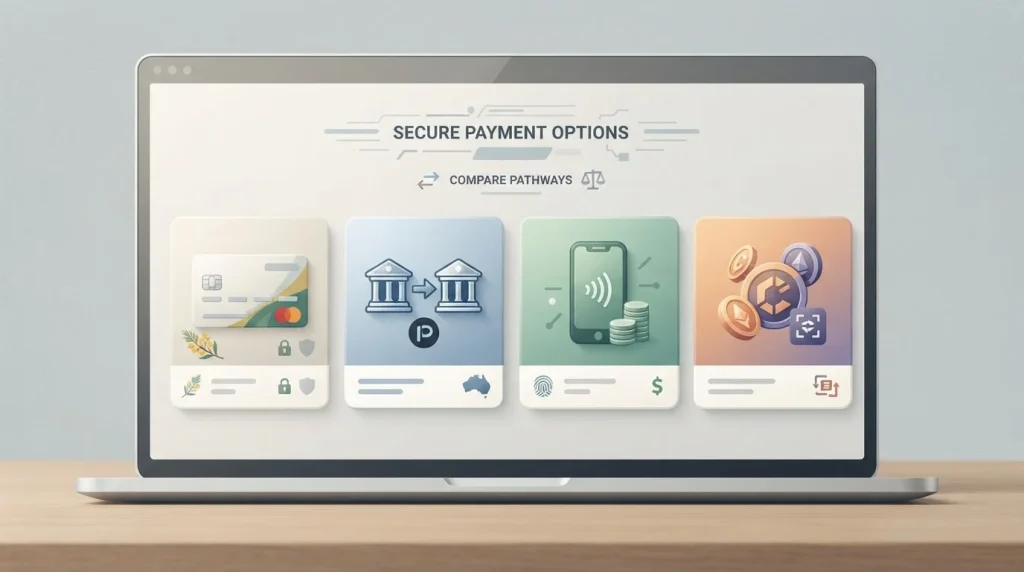
SpinBond supports Australian-dollar account and payment activity. Its current official terms and FAQ name Bitcoin, eZeeWallet, Mastercard, Neosurf and Visa as supported methods. PayID and bank transfer are also listed by two Australia-facing SpinBond sources, while Litecoin is corroborated across those sources and Ethereum appears on one of them. The practical point is that these methods do not all carry the same level of confirmation, and a method shown for deposits should not be assumed to work for withdrawals.
For an Australian reader, PayID is especially familiar, but familiarity is not the same as casino-specific certainty. The Reserve Bank of Australia’s 2025 survey found PayID had become mainstream, while cards still accounted for most consumer payments. Before sending money, check the live SpinBond cashier for the exact method, currency, ownership requirement, fees or limits shown for your account. AUD or PayID support also does not prove Australian regulatory authorisation.
Table of Contents
- SpinBond’s payment list is broader than one banking category
- AUD support can reduce one source of friction, but it does not remove every currency question
- Cards are familiar in Australia, but familiarity does not answer withdrawal compatibility
- PayID is mainstream in Australia, but its presence at SpinBond needs its own check
- Crypto adds a different set of decisions
- Deposit support and withdrawal support are two separate questions
- Check ownership and verification before choosing a payment route
- Do not infer fees or limits from the payment method name
- A five-point pre-deposit check
- Payment availability does not establish Australian authorisation
- Bottom line
- Related SpinBond guides
SpinBond’s payment list is broader than one banking category
SpinBond banking is more useful to compare by where each method is currently listed than as a flat row of logos. The casino’s official material names some methods directly, Australia-facing sources list several others, and a few have less consistent confirmation. The live cashier remains the final check for the actual account.
| Method or currency | Current support level | What to verify before use |
|---|---|---|
| AUD | Named in current SpinBond terms and FAQ | Confirm the account and transaction stay in AUD and whether any provider conversion applies |
| Visa and Mastercard | Named in current official material | Check whether the card is available for deposit, withdrawal, or both |
| eZeeWallet | Named in current official material | Check withdrawal availability and account-name matching |
| Neosurf | Named in current official material | Check whether it is deposit-only and which method would be used for a later withdrawal |
| Bitcoin | Named in current official material | Confirm the currency and wallet details shown in the cashier |
| PayID | Listed by two Australia-facing SpinBond sources | Verify that PayID appears for the actual account before transferring |
| Bank transfer | Listed by two Australia-facing SpinBond sources | Check the exact bank route, receiving details and withdrawal compatibility |
| Litecoin | Listed by two Australia-facing SpinBond sources | Confirm the current wallet/network option in the cashier |
| Ethereum | Listed on one Australia-facing source | Treat the live cashier as decisive before using it |
This distinction matters because a banking option can disappear from an account even when it remains visible on a general information page. Location, payment provider, account status and the direction of the transaction can all affect what the cashier displays. SpinBond’s own terms state that payment availability depends on location and method.
AUD support can reduce one source of friction, but it does not remove every currency question
AUD support is one of the clearest Australia-relevant product facts at SpinBond. Using an Australian-dollar account can make deposits, balances and spending limits easier to read because the player is not mentally converting every figure from another fiat currency. It can also make bonus thresholds expressed in A$ easier to compare with a fixed entertainment budget.
That does not mean every payment provider will necessarily settle without a currency conversion. A card issuer, wallet, crypto exchange or intermediary can apply its own pricing or conversion process outside the casino. The right pre-deposit question is therefore not simply “Does SpinBond support AUD?” It is “Will this specific transaction be charged, converted or settled in AUD from my chosen payment route?”
If the cashier shows a different settlement currency from the account balance, stop and understand that difference first. A conversion cost can change the amount that leaves a bank account even when the casino balance itself is denominated in Australian dollars.
Cards are familiar in Australia, but familiarity does not answer withdrawal compatibility
Cards remain Australia’s dominant consumer payment method. The Reserve Bank of Australia’s 2025 Consumer Payments Survey reported that cards accounted for about 73% of consumer payments, with debit cards alone accounting for roughly half. That makes Visa and Mastercard familiar choices for many Australian users, but the RBA data says nothing about whether a particular SpinBond account can withdraw back to a card.
This is where a general payment habit and a casino-specific banking rule must stay separate. A card can be accepted for a deposit while a later withdrawal requires another route. The live cashier and account rules determine that relationship. Do not choose a card on the assumption that the payout path will mirror the deposit path.
A useful check is to open the withdrawal section before depositing, even when no withdrawal is planned yet. If the casino does not show the same card there, note which alternatives are available and whether they require a separate wallet or bank account. This prevents the first serious look at payout compatibility from happening only after funds are already in the account.
PayID is mainstream in Australia, but its presence at SpinBond needs its own check
PayID has become a common Australian account-to-account payment tool. The RBA reported that around 80% of respondents in its 2025 survey were aware of PayID and around 50% had used it in the previous year, up from 32% in 2022. PayID lets a sender use an identifier such as a mobile number, email address or ABN rather than manually entering bank account details, and it shows the recipient name before payment.
That local familiarity helps explain why PayID matters for Australian users, but it is not proof that every SpinBond account will display it. PayID is not part of the core list named in the current SpinBond terms or FAQ. Two Australia-facing SpinBond sources list it, so the live cashier should be treated as the final check before a transfer.
Crypto adds a different set of decisions
Bitcoin is the strongest crypto payment fact for SpinBond because it is named in current official material and is also recognised as a supported currency. Litecoin is listed by two Australia-facing sources. Ethereum has less consistent confirmation, so it should be checked directly in the account rather than assumed from a broad crypto label.
Crypto removes the card-versus-bank question, but it introduces network and address questions. A wallet transfer normally cannot be treated like a reversible card purchase. The network, destination address and currency shown in the cashier need to match the transfer exactly. A user who holds one asset should not assume the casino accepts every asset or every network version of that asset.
There is also a budgeting difference. If the account records an AUD balance while the funding asset moves in price, the amount of crypto sent can change even when the intended Australian-dollar spend does not. Set the spending amount in AUD first, then check the quoted crypto amount at the time of the transaction rather than using an old conversion.
Deposit support and withdrawal support are two separate questions
A payment label on a casino page can hide an important asymmetry: some methods are designed mainly for funding, while others can handle both directions. A prepaid method such as Neosurf is a good example of why the distinction matters. Seeing it on the accepted-method list does not establish that winnings can be sent back through the same channel.
The same caution applies to PayID, cards and wallets. Before depositing, check both the deposit and withdrawal menus. If a method appears only on one side, identify the alternative payout method and any ownership requirements attached to it. SpinBond’s current terms also make verification relevant to payment processing, which means the name and account details connected to the chosen route should be consistent with the casino account.
For the actual payout sequence, processing window and where a delay can occur, use the dedicated SpinBond withdrawal processing guide. That page separates the casino’s internal review from the time taken by an outside bank, card route, wallet or blockchain.
Check ownership and verification before choosing a payment route
SpinBond’s current terms allow identity, age, residential-address and payment-method checks. The payment-method part is important here: a transaction can create extra friction if the funding method is not clearly owned or controlled by the account holder. Using another person’s card, bank account or wallet can create a mismatch that is avoidable before any deposit is made.
If the payment route requires an account name, keep it consistent with the details used for SpinBond registration. If verification is requested, the casino may also ask for evidence showing ownership of the deposit or withdrawal method. The detailed document categories and verification workflow are covered on the SpinBond KYC checks page.
The practical rule is simple: choose a payment method that belongs to you, can be documented if necessary, and has a clear withdrawal path. Convenience at the deposit stage is only one part of the banking decision.
Do not infer fees or limits from the payment method name
SpinBond’s current terms state that processing times, limits and fees vary by method, but they do not provide a stable public table with exact figures for every route. That means a Visa, PayID or crypto label is not enough to infer a deposit cap, withdrawal minimum, casino-side fee or bank charge.
Check the amount field and fee disclosure inside the cashier before confirming the transaction. If a payment provider adds a separate charge, distinguish that provider cost from any fee charged by SpinBond. The same distinction matters for crypto network fees, which can exist even when the casino does not add a separate transaction charge.
A useful comparison is the amount you intend to spend versus the amount that will actually leave the payment account. If those figures differ, understand why before proceeding. Exact cashier values are more relevant than an old payment table because these details can change by account and method.
A five-point pre-deposit check
- Currency: confirm the account and transaction are in the currency you expect, especially if the payment provider can convert funds.
- Method availability: verify the chosen card, PayID route, wallet, voucher or crypto asset is visible in the current cashier for the account.
- Ownership: use a payment method that belongs to the account holder and can be evidenced if verification is requested.
- Withdrawal path: check whether the same method appears for withdrawals or which alternative route would be required.
- Displayed costs and limits: read the current cashier values rather than importing an old fee or limit from another page.
The same checks apply whether you prefer a familiar card, Australian account-to-account transfer or crypto. Before sending a deposit, understand the complete money path, including the selected deposit route, withdrawal compatibility, limits, fees and verification requirements.
Payment availability does not establish Australian authorisation
AUD support, PayID visibility and Australian-facing payment information are product-access facts. They do not show that SpinBond holds an Australian licence or is authorised by the Australian regulator to provide online casino services. Those are separate legal questions that require regulator evidence rather than banking evidence.
This distinction prevents a common reasoning error. A service can adapt its cashier to local payment habits without that adaptation deciding its regulatory status. For the dedicated Australian analysis, see the page on Australian authorisation and SpinBond licence status.
Bottom line
SpinBond’s strongest directly confirmed banking facts are AUD and Bitcoin support plus Bitcoin, eZeeWallet, Mastercard, Neosurf and Visa in current official material. PayID, bank transfer and Litecoin have additional Australia-facing corroboration, while Ethereum deserves a direct cashier check because its support is less strongly confirmed.
For most readers, the best payment method is not simply the fastest-looking logo. It is the method that appears in the current account, uses the intended currency, belongs to the account holder, has a clear withdrawal route and displays acceptable fees and limits before confirmation. Return to the full SpinBond Australia review for the broader product assessment.
Related SpinBond guides
For related details, see SpinBond Australia review, SpinBond withdrawal methods, account setup, payment verification, and Australian authorisation.