SpinBond Registration and Account Rules in Australia
 Available in GB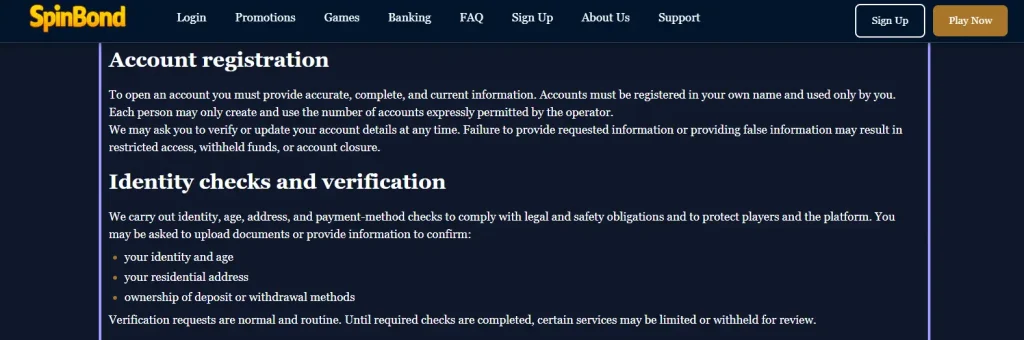
SpinBond’s account rules require accurate, complete and current information, personal use of the account and protection of login credentials. The casino can ask for identity, age, address or payment-method verification and can restrict account functions when requested information is missing or inconsistent. Registration therefore deserves to be treated as an account-governance decision, not simply as a route to a bonus.
For an Australian reader, one point needs to stay separate from those account rules: Australia-facing signals and AUD support do not prove that Australia is selectable in every live registration session, and they do not establish Australian regulatory authorisation. Before spending, check the live account interface, keep identity and payment details consistent, understand what verification can involve and set the control tools you want to use from the start.
Table of Contents
- Registration is about maintaining one consistent identity trail
- What information can become relevant to the account
- Do not assume country availability from AUD support alone
- A pre-account readiness check is more useful than a sign-up walkthrough
- Account security starts with the email and password
- Verification can affect account access and payments
- Review responsible-gambling controls before spending
- Payments should be planned from the withdrawal side as well
- What to do if login or account access fails
- Mobile registration follows the same account rules
- Bottom line
- Related SpinBond guides
Registration is about maintaining one consistent identity trail
The most important preparation happens before any payment. SpinBond’s terms say account information must be accurate, complete and current and that the account must be registered in the user’s own name and used personally. That creates a simple rule for everything that follows: the identity attached to the account should line up with the identity behind the email address, payment method and later verification evidence.
A mismatch can create friction long after the account was first opened. A nickname that does not match identity evidence, an old residential address, or a payment method owned by another person can turn into a verification question when money is already involved. Correcting the details early is easier than trying to explain inconsistent records during a withdrawal review.
Do not share login access with another person or let someone else use the account on your behalf. SpinBond’s terms make the account personal and place responsibility on the account holder for keeping credentials confidential. That is an account-security rule, not just a preference.
What information can become relevant to the account
SpinBond’s current terms allow checks covering identity, age, residential address and ownership of deposit or withdrawal methods. The exact evidence requested can depend on what the casino needs to verify in a particular account, and the public terms do not set one closed document list for every customer.
| Account area | Why consistency matters | Useful preparation |
|---|---|---|
| Identity and age | The account must belong to the person using it | Use your legal details accurately and keep them current |
| Residential address | Address checks can be part of verification | Do not leave an old address on the account if circumstances change |
| Email access | Email can be used for account notices and support follow-up | Use an address you control and protect it with strong authentication |
| Payment ownership | SpinBond can verify ownership of deposit or withdrawal methods | Prefer methods held in the account holder’s own name |
| Login credentials | The account is personal and access must remain confidential | Use a unique password and do not share it |
The dedicated SpinBond KYC requirements guide deals with verification categories in more detail. Registration itself should focus on making the account information coherent enough that later checks do not begin with avoidable contradictions.
Do not assume country availability from AUD support alone
SpinBond supports Australian-dollar account and payment activity, and multiple Australia-facing sources describe the brand as available to Australian players. Those are operational signals. They are not the same as seeing Australia selectable in the live registration form at the moment an account is created.
Country support can change because an operator can restrict access by location. SpinBond’s terms explicitly reserve the ability to restrict the platform in certain countries or regions. For that reason, the live country selector and any location message shown during registration are more useful than an old saved image or a third-party claim when deciding whether the form currently accepts a particular location.
This also prevents a second mistake: treating availability as proof of legality. ACMA states that providers must not offer prohibited online casino services to people in Australia. The full Australia legal context belongs on the licence and safety page, but an account opening decision should still recognise that operational access and Australian authorisation are different questions.
A pre-account readiness check is more useful than a sign-up walkthrough
A registration guide does not need a sequence of promotional clicks. What matters is whether the user is ready to maintain the account responsibly and answer predictable verification questions. Before entering details, work through the following checks.
- Use a personal email address that you can continue to access.
- Enter your real name and current details consistently rather than using a nickname or another person’s information.
- Use a unique password that is not reused across email, banking or other gambling accounts.
- Decide which payment method you would use and confirm that it belongs to you.
- Review the live cashier before depositing so you understand both deposit and withdrawal routes.
- Read the account-control options before gambling and decide whether deposit, loss or session limits would help define a fixed boundary.
- Understand the Australian regulatory context before spending money.
This sequence reduces preventable account friction without turning registration into an inducement. If any of the checks exposes a mismatch, resolve it before funds enter the account.
Account security starts with the email and password
SpinBond’s terms make the account holder responsible for keeping login details confidential and for reporting suspected unauthorised access. A strong password matters, but the email account linked to the casino also needs protection because password resets and support messages can pass through it.
Use a unique password and enable multi-factor authentication on the email account where available. Do not save casino credentials in a shared browser profile, and avoid logging in through links from unsolicited messages. On a phone, verify the domain before entering credentials and log out if another person can access the device.
If you suspect someone else has accessed the account, contact SpinBond promptly rather than continuing to deposit or play while the ownership question is unresolved. The current support email is [email protected], and live chat is also listed as a support route. Live-chat availability depends on staffing and site hours, so email can provide a written record when the issue requires follow-up.
Verification can affect account access and payments
SpinBond’s terms state that the casino can ask users to verify or update account details and can limit services until required checks are completed. That makes KYC a normal account dependency rather than an exceptional event that can be ignored until a large withdrawal is requested.
Identity and payment ownership are connected. If the name on the casino account differs from the name behind a card, bank account or wallet, the casino can have a reason to ask who controls the payment method. The cleanest preparation is to use a method that the account holder owns and to keep the account details accurate from the beginning.
Exact document requests should come from the live verification process or support. Do not send passports, licences, bank statements or full card details to an unverified email address simply because a third-party article says those files are “usually required”. Follow SpinBond’s secure upload instructions if verification is requested.
Review responsible-gambling controls before spending
SpinBond lists account controls that include deposit limits, loss limits, session limits and time reminders, reality checks, cooling-off options and self-exclusion. These tools are more useful when considered before gambling rather than after spending has already moved beyond the intended budget.
- Deposit limits
- Use them to place a boundary around how much can enter the account during a chosen period.
- Loss limits
- Use them to restrict how much can be lost over a defined period instead of relying only on willpower during play.
- Session limits and reminders
- Use time boundaries to prevent a short session from stretching unnoticed.
- Reality checks
- Use prompts as a deliberate point to review time spent and recent activity.
- Cooling-off and self-exclusion
- Use these options when a break or stronger access restriction is needed.
These are account-management tools, not proof of Australian licensing. They can still be evaluated as product features while the separate legal and regulatory questions remain distinct.
Payments should be planned from the withdrawal side as well
Registration is often treated as complete once a deposit method works. That is too narrow. A better readiness test is to check the withdrawal path before the first deposit. SpinBond’s payment options include Bitcoin, eZeeWallet, Mastercard, Neosurf and Visa in current official material, while the exact methods available can depend on the account and location.
Open the cashier and check which routes appear for both directions. If a deposit method does not appear for withdrawals, understand the alternative before committing funds. The SpinBond payments guide explains the difference between general method support and account-specific cashier availability.
Payment planning also supports verification readiness. A method in the account holder’s own name is easier to connect to the personal account if SpinBond asks for ownership evidence. Avoid using another person’s card, bank account or wallet simply because it is convenient at the moment of deposit.
What to do if login or account access fails
Start with the simplest checks: confirm the correct domain, verify the email or username being used, and check whether the browser has an old saved password. If a password reset is needed, use the account’s normal recovery process rather than links sent by an unknown third party.
If access remains restricted, contact SpinBond support and ask what status is blocking the account. Useful information includes the registered email address, the approximate time the problem began and any error message shown. Do not send passwords, one-time security codes or full payment-card numbers through ordinary email or chat.
If support says verification is required, move the issue into the KYC process instead of repeatedly trying to log in or create another account. Creating additional accounts to work around a restriction can complicate identity and ownership checks further.
Mobile registration follows the same account rules
SpinBond supports browser-based access on Android and iOS, so account pages can be reached from a phone without relying on a verified native app. Mobile access does not change the accuracy, ownership or verification rules attached to the account.
The main extra risk on mobile is environmental: shared devices, saved passwords, public Wi-Fi and small screens can make it easier to miss a domain change or payment detail. The site’s mobile guide explains browser compatibility and secure access in more detail. For registration, the principle is simple: use the same careful identity and security habits regardless of whether the account is reached from desktop or mobile.
Bottom line
SpinBond registration should be approached as the start of an account record that needs to remain accurate, personal and verifiable. Use real current details, protect the login and linked email, keep payment ownership consistent, and expect identity, age, address or payment-method checks when requested.
Do not infer current country acceptance or Australian authorisation from AUD support alone. Check the live account interface, understand the local legal context and decide on limits before spending. For the broader product assessment, return to the full SpinBond Australia review, read the KYC guide for verification detail, or compare the payment routes before funding an account.
Related SpinBond guides
For related details, see SpinBond Australia review, SpinBond KYC requirements, funding your account, and Australia legal context.